
[ad_1]

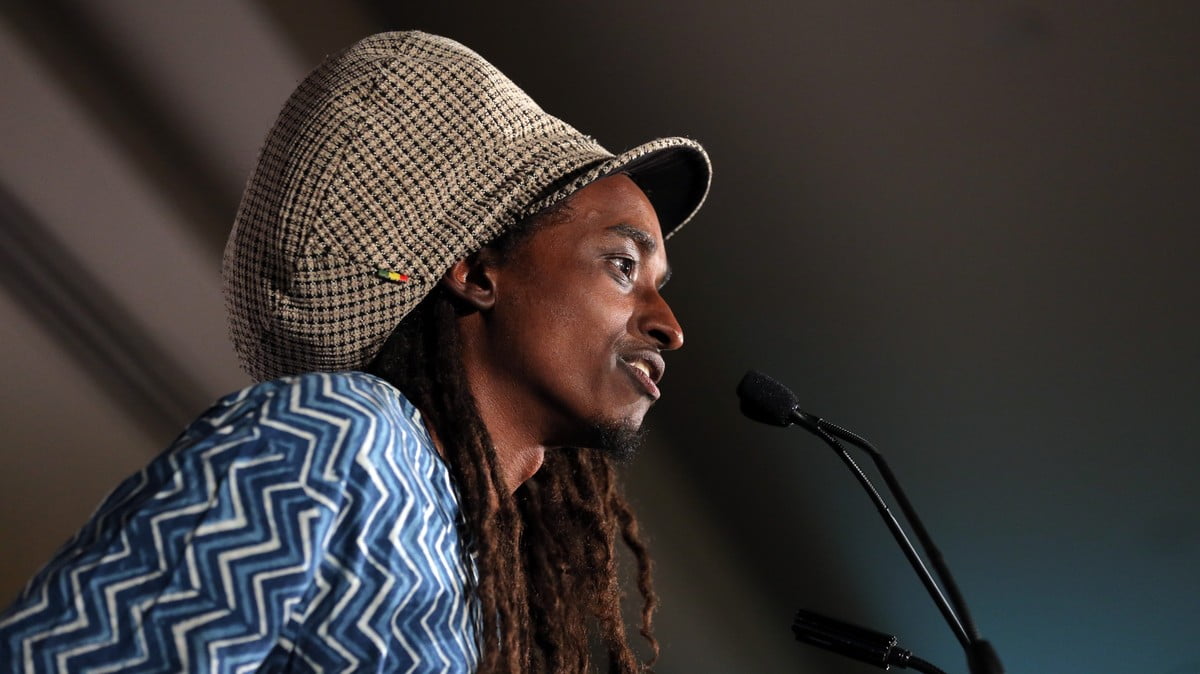
Renowned filmmaker Hajooj Kuka and four artists were released today from prison in Khartoum, almost two weeks after the group and six other artists were arrested in the Sudanese capital.
After his release, Kuka told VICE News that the fight for justice would continue, so that the Sudanese people “will be able to create art, we will be able to have freedom of speech, and move on.”
“The big thing that we hope will come through this also is getting rid of all these rules that could be used against us, and also, finding ways to protect first art and artists,” Kuka said. “Right now, the remainders of the old regime still use these laws that exist, and [there are] folks within the police, the judiciary, the prosecution office, that still believe in the old ways.
After his release, Kuka told VICE News that the fight for justice would continue, so that the Sudanese people “will be able to create art, we will be able to have freedom of speech, and move on.”
“The big thing that we hope will come through this also is getting rid of all these rules that could be used against us, and also, finding ways to protect first art and artists,” Kuka said. “Right now, the remainders of the old regime still use these laws that exist, and [there are] folks within the police, the judiciary, the prosecution office, that still believe in the old ways.
“I hope, in the future, people will also stand in solidarity when such things happen,” added Kuka.
Despite the release of Kuka, Duaa Tarig Mohamed Ahmed, Abdel Rahman Mohamed Hamdan, Ayman Khalaf Allah Mohamed Ahmed and Ahmed Elsadig Ahmed Hammad, concerns about freedom and justice in post revolution Sudan endure. Six other artists remain imprisoned, awaiting appeal.
On the day they wound up behind bars, hours after an altercation that would eventually see them sentenced to two months in prison on charges of “public annoyance and disruption of public safety,” the artists sang protest songs. A grainy cell phone video captured their act of defiance, their silhouettes clapping and chanting in a dark holding cell in Khartoum Central Prison. Their songs, reminiscent of the same subversive slogans that sparked Sudan’s uprising in late 2018, were intended to send a message: The revolution continues.
The regime of Omar al-Bashir, a dictator indicted by the International Criminal Court on charges of genocide, ended in 2019 after 30 years of iron-fisted rule. Bringing down al-Bashir and moving to a transitional government took more than 10 months of strikes and daily demonstrations in the East African nation, with millions marching in the streets to protest years of agonizing misrule that had brought the Sudanese economy to its knees. A year after the establishment of the transitional government, however, many of the promises of the Sudanese revolution remain unfulfilled, with sweeping reforms of the justice system still in limbo and hardline Islamist factions in the government clinging to the legacy of the al-Bashir regime. This, the artists said, explains their arrest: Kuka and the others insist that they were jailed on fabricated charges.
Kuka and the four co-defendants released today were sentenced on September 18; six others, who were tried separately on September 24, received the same sentence, which also carries a fine of five thousand Sudanese pounds, or 90 dollars. They are currently appealing that sentence. The charges stem from an incident in August during a mixed-gender theater workshop at Civic Lab, a community hub and cultural space in Khartoum. According to the artists, neighbors lodged a noise complaint against the group before physically assaulting them, continuing their attack after the arrival of the police.
On the day they wound up behind bars, hours after an altercation that would eventually see them sentenced to two months in prison on charges of “public annoyance and disruption of public safety,” the artists sang protest songs. A grainy cell phone video captured their act of defiance, their silhouettes clapping and chanting in a dark holding cell in Khartoum Central Prison. Their songs, reminiscent of the same subversive slogans that sparked Sudan’s uprising in late 2018, were intended to send a message: The revolution continues.
The regime of Omar al-Bashir, a dictator indicted by the International Criminal Court on charges of genocide, ended in 2019 after 30 years of iron-fisted rule. Bringing down al-Bashir and moving to a transitional government took more than 10 months of strikes and daily demonstrations in the East African nation, with millions marching in the streets to protest years of agonizing misrule that had brought the Sudanese economy to its knees. A year after the establishment of the transitional government, however, many of the promises of the Sudanese revolution remain unfulfilled, with sweeping reforms of the justice system still in limbo and hardline Islamist factions in the government clinging to the legacy of the al-Bashir regime. This, the artists said, explains their arrest: Kuka and the others insist that they were jailed on fabricated charges.
Kuka and the four co-defendants released today were sentenced on September 18; six others, who were tried separately on September 24, received the same sentence, which also carries a fine of five thousand Sudanese pounds, or 90 dollars. They are currently appealing that sentence. The charges stem from an incident in August during a mixed-gender theater workshop at Civic Lab, a community hub and cultural space in Khartoum. According to the artists, neighbors lodged a noise complaint against the group before physically assaulting them, continuing their attack after the arrival of the police.
At the police station, the artists said, an officer took pictures of Tarig, the 28-year-old workshop director, on his personal mobile phone. When she protested, he beat her until she lost consciousness, prompting the others to intervene. Advocates for the artists said that the police refused their requests to file reports about the police assault, and denied them medical care and their right to speak with their families.
Kuka told VICE News in an exclusive interview from prison on September 23 that the group arrived at the station expecting to press charges against their assailants, not to be charged themselves. “It was very shocking to us,” he said.
The international outcry sparked by their case has been swift. Kuka holds dual citizenship with Sudan and the United States, and is a member of the Academy of Motion Picture Arts and Sciences, the governing body that awards the Oscars. A number of high-profile institutions, including the European Film Academy and the Venice, Toronto, Berlin, and Sundance film festivals, were quick to rally to the defense of Kuka and the other artists, calling for their release. But the artists have been determined not to become causes célèbre, or pawns in some wider geopolitical chess match. Instead, they want to draw attention to the many al-Bashir-era laws still present in Sudan, in order to obtain sweeping judicial reform.
Now, they insist, is the right time to do it. “Sudan has a lot of issues, and normally personal freedoms, women’s participation—because this is the main, core issue of our case—these are put to the side,” Kuka told VICE News. “Because you’re always dealing with coronavirus, you’re dealing with peace and signing treaties, you’re dealing with ethnic violence, you’re dealing with flooding. It’s always, ‘This is not the time to deal with it.’”
Kuka told VICE News in an exclusive interview from prison on September 23 that the group arrived at the station expecting to press charges against their assailants, not to be charged themselves. “It was very shocking to us,” he said.
The international outcry sparked by their case has been swift. Kuka holds dual citizenship with Sudan and the United States, and is a member of the Academy of Motion Picture Arts and Sciences, the governing body that awards the Oscars. A number of high-profile institutions, including the European Film Academy and the Venice, Toronto, Berlin, and Sundance film festivals, were quick to rally to the defense of Kuka and the other artists, calling for their release. But the artists have been determined not to become causes célèbre, or pawns in some wider geopolitical chess match. Instead, they want to draw attention to the many al-Bashir-era laws still present in Sudan, in order to obtain sweeping judicial reform.
Now, they insist, is the right time to do it. “Sudan has a lot of issues, and normally personal freedoms, women’s participation—because this is the main, core issue of our case—these are put to the side,” Kuka told VICE News. “Because you’re always dealing with coronavirus, you’re dealing with peace and signing treaties, you’re dealing with ethnic violence, you’re dealing with flooding. It’s always, ‘This is not the time to deal with it.’”
Since the ouster of al-Bashir last year, Sudan has been run by a transitional government composed of both military and civilian leaders, and ostensibly moved away from the hardline stance of the dictator’s regime. Yet, local civil society groups insist that the recent arrests point to the lingering influence of al-Bashir loyalists on Sudanese institutions.
“I am very concerned about the whole case,” said Yosra Akasha, of the Strategic Initiative for Women in the Horn of Africa (SIHA). “It has shown us as activists and civil society in Sudan that the space isn’t as open as we thought it would be.” Created under the al-Bashir regime, the Sudanese legal framework is rife with ambiguities, empowering the jurisdiction of state security actors over civilians.
“The police used vaguely worded public nuisance laws which have been on the books for decades,” Jehanne Henry, the East Africa Director for Human Rights Watch, told VICE News. “The laws give wide discretion to the arresting officers to determine what a nuisance is or is not.”
Additionally, religious hardliners still wield power. “The Islamist influence on the police, the judiciary, and the military, and even within the civil service, it’s still high,” Akasha said. “We can see that in the attitudes of the law enforcement and the decisions the judges are handing to people, specifically when it comes to [the] criminalization of personal behaviors.”
“I am very concerned about the whole case,” said Yosra Akasha, of the Strategic Initiative for Women in the Horn of Africa (SIHA). “It has shown us as activists and civil society in Sudan that the space isn’t as open as we thought it would be.” Created under the al-Bashir regime, the Sudanese legal framework is rife with ambiguities, empowering the jurisdiction of state security actors over civilians.
“The police used vaguely worded public nuisance laws which have been on the books for decades,” Jehanne Henry, the East Africa Director for Human Rights Watch, told VICE News. “The laws give wide discretion to the arresting officers to determine what a nuisance is or is not.”
Additionally, religious hardliners still wield power. “The Islamist influence on the police, the judiciary, and the military, and even within the civil service, it’s still high,” Akasha said. “We can see that in the attitudes of the law enforcement and the decisions the judges are handing to people, specifically when it comes to [the] criminalization of personal behaviors.”
That influence is especially pronounced when it comes to the role of women in the public sphere. Despite a series of well-publicized amendments to the penal code earlier this year, including the criminalization of female genital mutilation and the loosening of laws that required a woman to get permission from a male relative to travel with her children, Akasha insisted that “the judiciary and law enforcement are still abusing their power to target women in public spaces because of their appearance and because of their existence.” Among the most contentious statutes is the personal status law, which governs legal procedures in Sudan that pertain to family issues such as marriage, divorce, child custody, and inheritance. “The personal status law is built on the ideology that women are not equal citizens to men, because they need to have a guardian, and the guardian can decide on their marriage, on their access to resources, including education, including work opportunities,” said Akasha.
The Sudanese penal code still doesn’t protect women from gender-based violence or harassment, either at home or in the workplace. And the government has yet to sign onto the Convention on the Elimination of All Forms of Discrimination Against Women, a statute adopted in 1979 by the United Nations that is often described as “an international bill of rights for women.”
“There is no legal framework that protects women’s rights, or works as a reference to amend the legal system,” Akasha said.
The Sudanese penal code still doesn’t protect women from gender-based violence or harassment, either at home or in the workplace. And the government has yet to sign onto the Convention on the Elimination of All Forms of Discrimination Against Women, a statute adopted in 1979 by the United Nations that is often described as “an international bill of rights for women.”
“There is no legal framework that protects women’s rights, or works as a reference to amend the legal system,” Akasha said.
Kuka said that their group was targeted by Islamist neighbors because of the participation of several women in the workshop. The Civic Lab, he noted, has never received a complaint on any of its popular movie nights, though the typically boisterous (and mostly male) affairs often last until 1 am. “With this one, it was around 4 pm, and we were finishing before [the coronavirus] curfew…and the issue was we had women participating in the theater body movement workshop,” he said. During the attack, he added, the assailants specifically singled out Tarig, the only woman in the group.
When Tarig was still imprisoned, Akasha visited the artist in the women’s-only facility where Tarig was held, under conditions the activist described as “catastrophic.” “The prison is overpopulated,” she said, noting that Tarig shared a crowded cell with roughly 100 inmates. “There is limited access for clean drinking water. The women in that cell, they drink from the toilets.” Whereas Kuka and the other male prisoners had been meeting with their lawyers and members of civil society without supervision, visits in the women’s prison were closely monitored by prison guards.
Despite the conditions, pressure from the international film community made a difference. After the arrests, Kuka was beaten by prison guards, who cut his dreadlocks. After news of his mistreatment spread on social media, Sudan’s Minister of Youth, Sports and Culture visited the prison, and conditions dramatically improved overnight—not just for the artists, but for all the prisoners. “And that’s all because [of] the solidarity that we received,” Kuka said.
When Tarig was still imprisoned, Akasha visited the artist in the women’s-only facility where Tarig was held, under conditions the activist described as “catastrophic.” “The prison is overpopulated,” she said, noting that Tarig shared a crowded cell with roughly 100 inmates. “There is limited access for clean drinking water. The women in that cell, they drink from the toilets.” Whereas Kuka and the other male prisoners had been meeting with their lawyers and members of civil society without supervision, visits in the women’s prison were closely monitored by prison guards.
Despite the conditions, pressure from the international film community made a difference. After the arrests, Kuka was beaten by prison guards, who cut his dreadlocks. After news of his mistreatment spread on social media, Sudan’s Minister of Youth, Sports and Culture visited the prison, and conditions dramatically improved overnight—not just for the artists, but for all the prisoners. “And that’s all because [of] the solidarity that we received,” Kuka said.
“We are absolutely thrilled that Hajooj Kuka and the other four artists have just been released from prison after their appeal,” Steven Markovitz, who produced both of Kuka’s feature films, told VICE News. “The global solidarity really made a difference. The global film community and artists and activists in Sudan really came together over this.”
Kuka is among a generation of filmmakers leading a revival in Sudan’s fledgling film industry, which was all but decimated by strict regulations under the Islamic law imposed by the al-Bashir regime, as well as decades of economic hardship. His debut film, “Beats of the Antonov,” which won the audience award for best documentary in Toronto in 2014, is an uplifting portrait of resilience among displaced persons in the Blue Nile region, who rally together through music, song and dance as Russian-made Antonov planes bomb their settlements in the Nuba Mountains.
His sophomore feature, “aKasha,” which premiered at the Venice Film Festival, is an offbeat comedy centered on a “love triangle” between a young rebel, his romantic interest, and the AK-47 he hastily abandoned while trying to flee the annual round-up of rebel soldiers. Both films reflect the sensitivities of an artist bearing unflinching witness to the traumas suffered by his countrymen, while depicting the Sudanese in all their humor and humanity.
“In only two films, Hajooj Kuka has established himself as one of Africa’s most vital, original filmmaking voices,” said Cameron Bailey, the artistic director and co-head of the Toronto International Film Festival. “His films have travelled widely and brought life in Sudan to countless viewers all over the world. We need to protect his voice as a filmmaker, and I hope Sudan feels the same way.”
Kuka is among a generation of filmmakers leading a revival in Sudan’s fledgling film industry, which was all but decimated by strict regulations under the Islamic law imposed by the al-Bashir regime, as well as decades of economic hardship. His debut film, “Beats of the Antonov,” which won the audience award for best documentary in Toronto in 2014, is an uplifting portrait of resilience among displaced persons in the Blue Nile region, who rally together through music, song and dance as Russian-made Antonov planes bomb their settlements in the Nuba Mountains.
His sophomore feature, “aKasha,” which premiered at the Venice Film Festival, is an offbeat comedy centered on a “love triangle” between a young rebel, his romantic interest, and the AK-47 he hastily abandoned while trying to flee the annual round-up of rebel soldiers. Both films reflect the sensitivities of an artist bearing unflinching witness to the traumas suffered by his countrymen, while depicting the Sudanese in all their humor and humanity.
“In only two films, Hajooj Kuka has established himself as one of Africa’s most vital, original filmmaking voices,” said Cameron Bailey, the artistic director and co-head of the Toronto International Film Festival. “His films have travelled widely and brought life in Sudan to countless viewers all over the world. We need to protect his voice as a filmmaker, and I hope Sudan feels the same way.”
This isn’t the first time Kuka has fought for justice in Sudan. Last spring, he was among the artists, musicians and countless Sudanese who occupied a sprawling sit-in camp in central Khartoum. For two months protesters gathered, first to voice their grievances against the al-Bashir regime, and later to demand democratic elections for a civilian government, after the dictator was ousted in a military coup. Colorful murals festooned the walls just steps from the country’s military headquarters, while the sounds of reggae concerts, drum circles, and revolutionary call-and-response chants echoed deep into the night.
The sit-in was the revolution’s nerve center, a place where the oppressive strictures of Islamist rule gave way to a free-wheeling exercise in participatory self-governance. Pop-up kitchens and medical clinics were fully staffed by volunteers, who also manned checkpoints throughout the mile-long encampment to keep out the state security apparatus, as well as others with Islamist sympathies. The sit-in infused the revolution with the hope and promise that a new era in the history of post-colonial Sudan was about to dawn.
That ended on June 3, 2019, after a bloody rampage by security forces left more than 100 dead and hundreds wounded. The massacre came at the hands of the ruling military junta that seized power after al-Bashir was forced to step down on April 11, 2019. It was the most violence to erupt in Sudan since the strongman’s ouster, drawing condemnation from the African Union, which temporarily suspended the country’s membership until it agreed to hand control to a civilian-led government.
Artists say that for them, the continued fight is especially urgent. “From my side, nothing changed,” said Asim Zurgan, a bass guitarist and vocalist who took part in the protests, and whose band, Reggae Everywhere, performed for protesters at the sit-in camp in Khartoum. “We still see the police and the community dealing with art as a sin and a crime. Maybe the only thing is that now we can raise our voices, but we have a long way to go.”
Zurgan and other members of Sudan’s arts community are currently drafting a charter that would encode protections for artists’ rights and freedom of expression into Sudanese law. The charter, he said, has already united groups across the country, rekindling memories of the revolutionary spirit that animated Sudan a year ago. “I believe that we defeated the al-Bashir regime with art, so I believe art and music is the real revolution.”
From behind bars, Kuka had expressed hope that their imprisonment, and the need for necessary legal reform, will turn the page on a fresh chapter in the ongoing struggle for freedom and justice in post-revolution Sudan.
“To me, I’m hoping [for] a new generation of artists, activists, folks who just want to live their lives and do their things…[and realize] the dream of a new Sudan that we envision, where you have diversity, you have participation,” Kuka said. “And then you can go forward without all the baggage that we had from the old dictatorship, and the old Arab, Islamic vision that they had for us.”
The sit-in was the revolution’s nerve center, a place where the oppressive strictures of Islamist rule gave way to a free-wheeling exercise in participatory self-governance. Pop-up kitchens and medical clinics were fully staffed by volunteers, who also manned checkpoints throughout the mile-long encampment to keep out the state security apparatus, as well as others with Islamist sympathies. The sit-in infused the revolution with the hope and promise that a new era in the history of post-colonial Sudan was about to dawn.
That ended on June 3, 2019, after a bloody rampage by security forces left more than 100 dead and hundreds wounded. The massacre came at the hands of the ruling military junta that seized power after al-Bashir was forced to step down on April 11, 2019. It was the most violence to erupt in Sudan since the strongman’s ouster, drawing condemnation from the African Union, which temporarily suspended the country’s membership until it agreed to hand control to a civilian-led government.
Artists say that for them, the continued fight is especially urgent. “From my side, nothing changed,” said Asim Zurgan, a bass guitarist and vocalist who took part in the protests, and whose band, Reggae Everywhere, performed for protesters at the sit-in camp in Khartoum. “We still see the police and the community dealing with art as a sin and a crime. Maybe the only thing is that now we can raise our voices, but we have a long way to go.”
Zurgan and other members of Sudan’s arts community are currently drafting a charter that would encode protections for artists’ rights and freedom of expression into Sudanese law. The charter, he said, has already united groups across the country, rekindling memories of the revolutionary spirit that animated Sudan a year ago. “I believe that we defeated the al-Bashir regime with art, so I believe art and music is the real revolution.”
From behind bars, Kuka had expressed hope that their imprisonment, and the need for necessary legal reform, will turn the page on a fresh chapter in the ongoing struggle for freedom and justice in post-revolution Sudan.
“To me, I’m hoping [for] a new generation of artists, activists, folks who just want to live their lives and do their things…[and realize] the dream of a new Sudan that we envision, where you have diversity, you have participation,” Kuka said. “And then you can go forward without all the baggage that we had from the old dictatorship, and the old Arab, Islamic vision that they had for us.”
[ad_2]
Source link